Table of Contents
Filter paper moisture is easy to overlook because the sheet may appear dry even after it has exchanged water vapor with the surrounding air. Yet that exchange can influence roll flatness, flexibility, dimensions, tensile behavior, feeding, and the repeatability of laboratory measurements. When a roll wrinkles or tears, teams often change the media grade before checking whether storage and temperature history changed first.
This filter paper moisture guide explains how to investigate the condition without assuming that every handling problem is caused by the paper. It is written for warehouse, quality, production, maintenance, and procurement teams that need to distinguish normal moisture equilibrium from condensation, liquid contamination, packaging failure, or a machine problem.
The objective of a filter paper moisture review is a repeatable decision: release the roll, allow it to acclimate, run a controlled trial, place it on hold, or reject it. No single moisture value is suitable for every filter paper construction or process. Use supplier information, a known reference roll, consistent conditioning, and evidence from the intended equipment.
Why Moisture Changes More Than Paper Weight
Paper is hygroscopic: its fibers can gain or lose water as temperature and relative humidity change. Filter paper moisture therefore moves toward equilibrium with its environment rather than remaining permanently fixed after manufacture. The rate and effect depend on fiber composition, basis weight, bonding, surface treatment, roll diameter, packaging, and how long the material is exposed.
Filter paper moisture gain can change the dimensions and mechanical response of a sheet. Filter paper moisture loss can also matter, particularly when paper becomes less flexible during unwinding or passes around small rollers. The direction of change is not enough to predict performance: two grades with similar filter paper moisture may behave differently because their fiber networks and wet-strength systems differ.
This is why a procurement specification should not substitute an isolated moisture number for permeability, thickness, tensile properties, retention, or application testing. Treat filter paper moisture as one condition variable that can alter how those properties are measured and experienced.
Recognize Moisture-Related Symptoms on the Machine
A filter paper moisture problem usually appears through handling symptoms rather than a dashboard alarm. Look for a change that follows a new lot, a warehouse move, a season, a cold delivery, opened packaging, or a known leak. Record when the symptom begins and whether it spans the full width or only one edge.
- Wavy edges or baggy center: may indicate uneven moisture exposure, but can also result from winding tension or support geometry.
- Wrinkles after a guide or nip: can reflect dimensional instability, misalignment, uneven tension, or a damaged roll edge.
- Layer blocking: may follow direct moisture exposure, compression, heat, or a surface treatment issue.
- Frequent web breaks: require checks of filter paper moisture, dry and wet strength, sharp contact points, core fit, and machine tension.
- Roll telescoping or poor tracking: may originate in winding, impact damage, storage orientation, or a nonuniform environment.
- Unexpected flow change: should be investigated with process temperature, liquid viscosity, solids load, cake condition, and media identity—not moisture alone.
Photograph the unused roll, core, edges, paper path, wet web, and cake before adjusting several variables. A useful filter paper moisture investigation preserves the original condition and compares it with a known acceptable roll under the same setup.
Separate Warehouse Humidity from Direct Water Exposure
Normal exchange with humid air is not the same as liquid water contacting the roll. Ambient humidity can alter filter paper moisture gradually and sometimes unevenly after packaging is opened. Direct water exposure can create local saturation, stains, bonded layers, core damage, contaminants, or biological growth. A filter paper moisture procedure should give these conditions different dispositions.
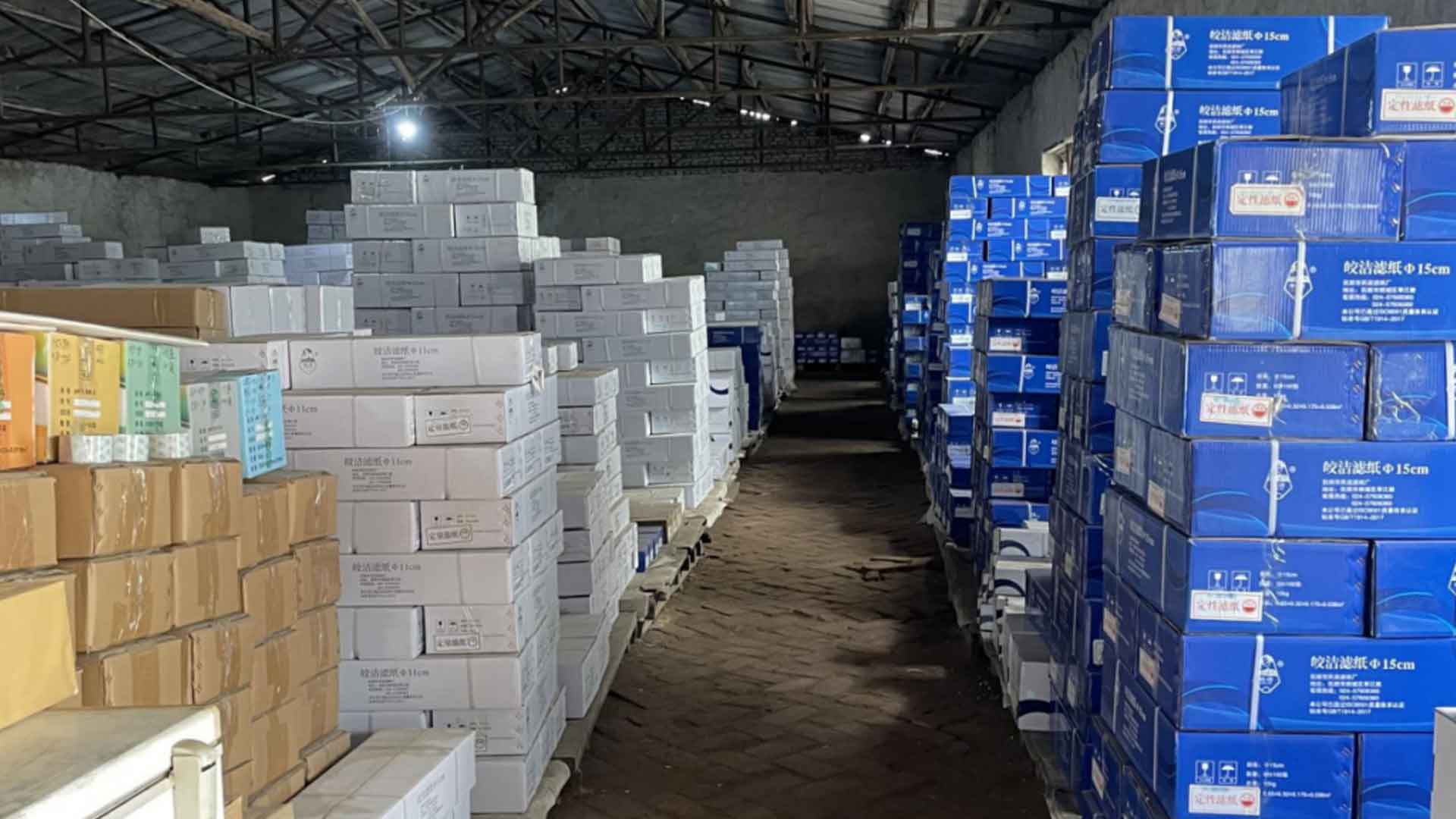
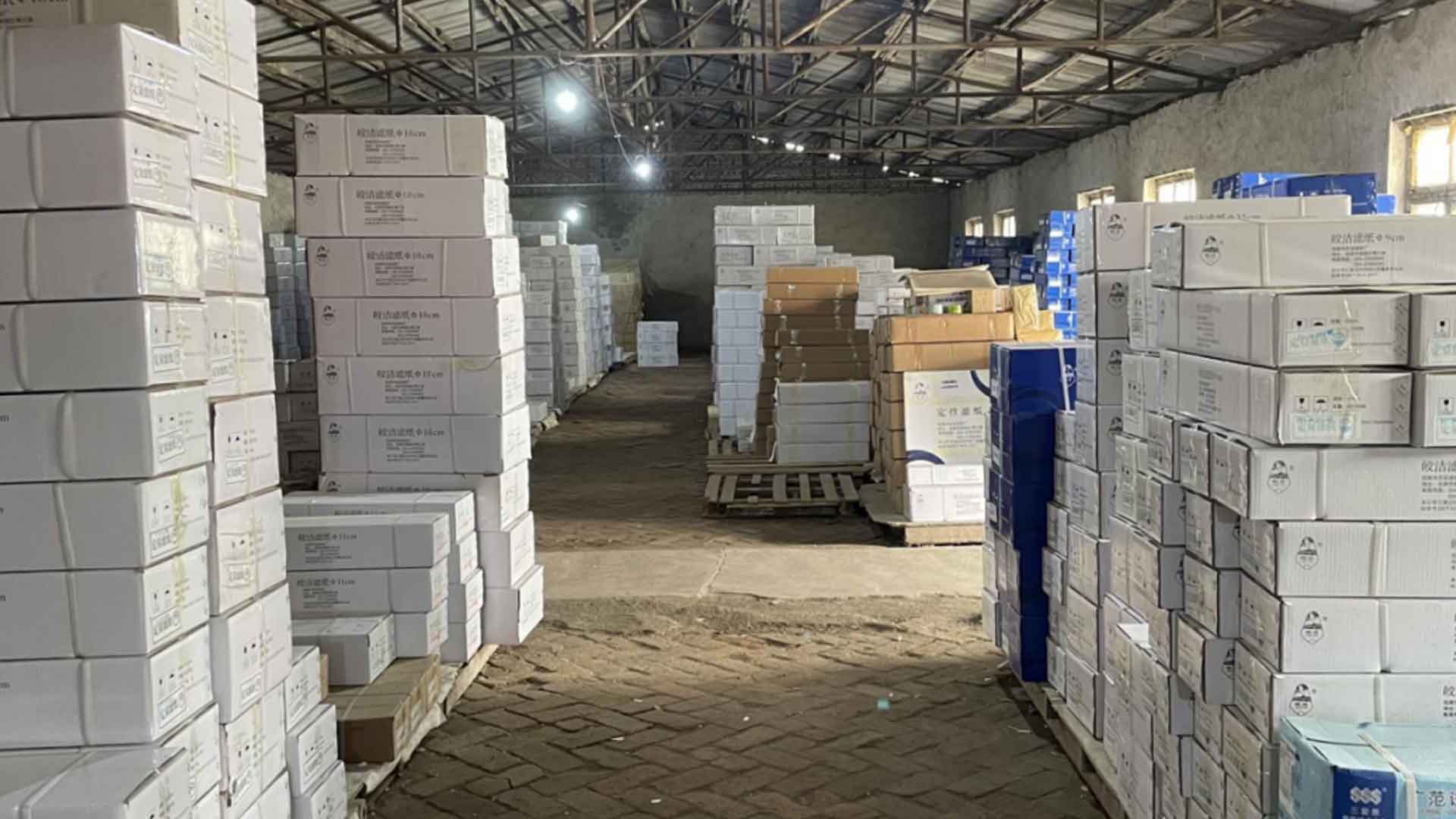
Map the storage location before blaming the media. Check roof and pipe history, exterior doors, washed floors, steam lines, heaters, windows, evaporative cooling, and whether rolls sit directly on concrete. Review environmental records at the roll location rather than relying only on a sensor across the warehouse. The filter paper storage guide gives a broader warehouse-control checklist.
Any roll with visible water damage, suspected contamination, a musty odor, or mold-like growth should be segregated under the site’s filter paper moisture, safety, and quality procedure. Do not try to “dry it out” and return it to unrestricted stock. Drying may remove free water without reversing distortion, contamination, or changes to the core and converted edges.
Prevent Condensation During Temperature Changes
Condensation can create a filter paper moisture problem when a cold roll enters warm, humid air and its surface remains below the air’s dew point. The risk is easy to miss because protective wrapping may conceal droplets. Opening the package immediately can expose more cold surface while preventing the roll from warming gradually inside its barrier.
Keep a cold delivery wrapped while it acclimates in the intended storage or production environment. The time needed depends on roll mass, diameter, starting temperature, packaging, and the temperature difference; a universal number would be unreliable. Record arrival and release times, and use surface or core-area temperature measurements where the local procedure permits.
Dew point is more informative than relative humidity alone when evaluating filter paper moisture and condensation. The U.S. National Weather Service explanation of dew point and NIST humidity metrology resources provide useful background, while facility decisions should rely on suitable indoor instruments and local procedures. Once visible condensation or water intrusion has occurred, assess the roll as exposed material rather than assuming acclimation will restore it.
Condition Samples Before Comparing Filter Paper
Filter paper moisture comparisons become misleading when one sample comes directly from a cold warehouse and another has equilibrated in the test room. Filter paper moisture can influence mass, thickness, dimensions, and strength results. Condition specimens consistently before comparing lots or suppliers, and report the conditioning atmosphere with the test result.
ISO 187 describes standard atmospheres for conditioning and testing paper, board, and pulp. The applicable contract may specify another recognized method, so procurement and quality teams should agree on the method, allowable atmosphere, conditioning time, sampling locations, and how specimens are protected between sampling and testing.
Do not use a handheld meter for filter paper moisture without understanding its calibration and material assumptions. Capacitance or resistance instruments may be useful for relative screening across similar rolls, but a reading is not automatically equivalent to an oven-dry laboratory moisture result. Establish a filter paper moisture baseline with known acceptable material and confirm unusual readings by an agreed reference method.
Check a Suspect Roll Without Damaging It
Place the roll on hold before sampling so it cannot be installed while the filter paper moisture investigation is open. Review lot identity, receipt date, packaging status, storage location, temperature transitions, opening history, and any environmental excursion. Compare those records and filter paper moisture measurements with an unaffected roll from the same grade if available.
- Inspect the wrap, pallet, core ends, and roll edges before opening.
- Photograph stains, waviness, crushed edges, telescoping, or separated layers.
- Unwrap only as much as the sampling plan requires in a clean area.
- Take samples from documented positions; avoid relying on a single exposed outer layer.
- Condition the samples and comparison specimens together.
- Check the properties tied to the failure risk, then preserve samples for supplier review.
If the primary symptom is tearing, use the site’s filter paper tensile strength guide to distinguish dry handling, liquid exposure, machine direction, support, and tension effects. If the concern is flow, compare under consistent conditioning and process conditions using the filter paper permeability guide.
Use a Moisture Decision Table
| Evidence | Likely classification | Recommended action |
|---|---|---|
| Intact wrap, complete history, stable dimensions, acceptable conditioned tests | Normal equilibrium | Release and retain the inspection record |
| Cold delivery, intact wrap, no water evidence | Condensation risk | Keep wrapped, acclimate, then inspect before opening |
| Opened roll with edge waviness but no contamination | Uneven exposure or winding issue | Hold, condition representative samples, inspect roll geometry, and trial if justified |
| Wet packaging, stains, odor, core swelling, bonded layers, or mold-like growth | Direct exposure or contamination | Segregate and follow rejection, claim, and disposal procedures |
| Acceptable measurements but wrinkles begin at one guide | Machine interaction likely | Inspect alignment, support, tension, and contact points before changing grade |
This filter paper moisture table is a triage tool, not a universal acceptance specification. Define who can release material, what evidence is mandatory, how long a hold may remain open, and when the supplier or equipment specialist must be involved.
Run a Controlled Production Trial
When filter paper moisture is suspected but inspection and conditioned tests do not justify rejection, a controlled trial can connect laboratory evidence with actual handling. Use equipment where a web break or performance change can be managed safely. Follow machine guarding and energy-control procedures; never defeat an interlock to observe the paper path.
Install the roll using the filter paper roll installation checklist. Hold width, grade, tension, guides, support condition, liquid temperature, production mix, and other settings stable. Record wrinkles, tracking, tears, advancement, liquid level or pressure, filtrate appearance, and cake release. Compare with a known acceptable roll rather than relying on memory.
A satisfactory filter paper moisture trial supports release only for the tested condition. It does not prove that every roll exposed to the same warehouse is acceptable or that filter paper moisture has no effect. Document the decision, limits, lot, equipment, dates, and any follow-up monitoring.
Specify Packaging and Handling with the Supplier
Filter paper moisture control begins before the shipment reaches your dock. Tell the supplier about transport climate, storage duration, roll size, unloading method, and whether partial rolls will be returned to stock. Ask how the packaging protects against water vapor and physical damage, how core ends are supported, and which storage conditions and acclimation practices apply to the selected construction.
Purchase documents should identify the grade, dimensions, core, roll direction, lot traceability, packaging, and agreed test methods. If filter paper moisture is a controlled acceptance property, state the method and conditioning rather than listing a number without context. Request retained samples or certificates only when they support a defined decision.
For broader filter paper moisture and paper-preservation context, the Library of Congress guidance on paper care explains the roles of temperature, moisture, light, and pollutants. Industrial media still require supplier- and application-specific limits, but these principles reinforce why stable, clean, dry storage is preferable to repeated environmental cycling.
Frequently Asked Questions
Can high filter paper moisture reduce strength?
It can change mechanical behavior, but the effect depends on fiber composition, bonding, treatment, direction, and whether the paper is merely humid or directly wetted. Compare conditioned specimens and application handling rather than assuming one universal relationship.
How long should a cold filter paper roll acclimate?
There is no reliable universal time. Roll mass, diameter, packaging, starting temperature, room conditions, and dew point all matter. Keep the roll wrapped, monitor temperatures under an approved procedure, and open it only when condensation risk is controlled.
Can a handheld meter measure filter paper moisture accurately?
A suitable meter may help screen similar rolls, but calibration and material assumptions matter. Establish a baseline with acceptable media and confirm disputed results using the contractual or laboratory reference method.
Can a damp roll be dried and reused?
Do not assume so. Direct water exposure may leave distortion, contamination, bonded layers, damaged cores, or altered treatments after the surface feels dry. Segregate the roll and use the site’s quality, safety, supplier-claim, and disposal process.
Why do test results change between the warehouse and laboratory?
Different sample conditioning, temperature, relative humidity, sampling positions, instruments, and methods can all contribute. Condition reference and test specimens together and record the complete method before concluding that the production lot changed.
Discuss a Moisture or Handling Problem
Before requesting a replacement grade, collect the current media identification, lot, roll dimensions, packaging condition, storage and temperature history, photographs, test method, equipment path, liquid, solids, operating settings, and the exact symptom. This evidence helps separate filter paper moisture from winding, installation, machine, and process causes.
Contact Fushun Civil Affairs Filter Paper Factory to discuss industrial filter paper formats, packaging, samples, and application details. Final acceptance should remain based on the agreed specification and verification in the intended process.