
When industrial buyers compare filtration media, filter paper GSM is often the first number placed side by side. That is understandable: it is easy to read, include in a purchase order, and verify by weighing a known area. The problem begins when GSM is treated as a shortcut for filtration accuracy.
It is not.
A heavier paper may be thicker, stronger, or able to hold more solids, but it does not automatically have smaller pores or capture finer particles. Two papers with the same filter paper GSM can also behave very differently because their fibers, formation, compression, surface structure, wet strength, and permeability are different.
This guide explains what filter paper GSM actually measures, what it cannot tell you, and how B2B buyers can combine it with thickness, flow, retention, and process data to select a more reliable industrial grade. For available sheet formats and customization options, see our large industrial filter paper.
Table of Contents
What Does Filter Paper GSM Mean?
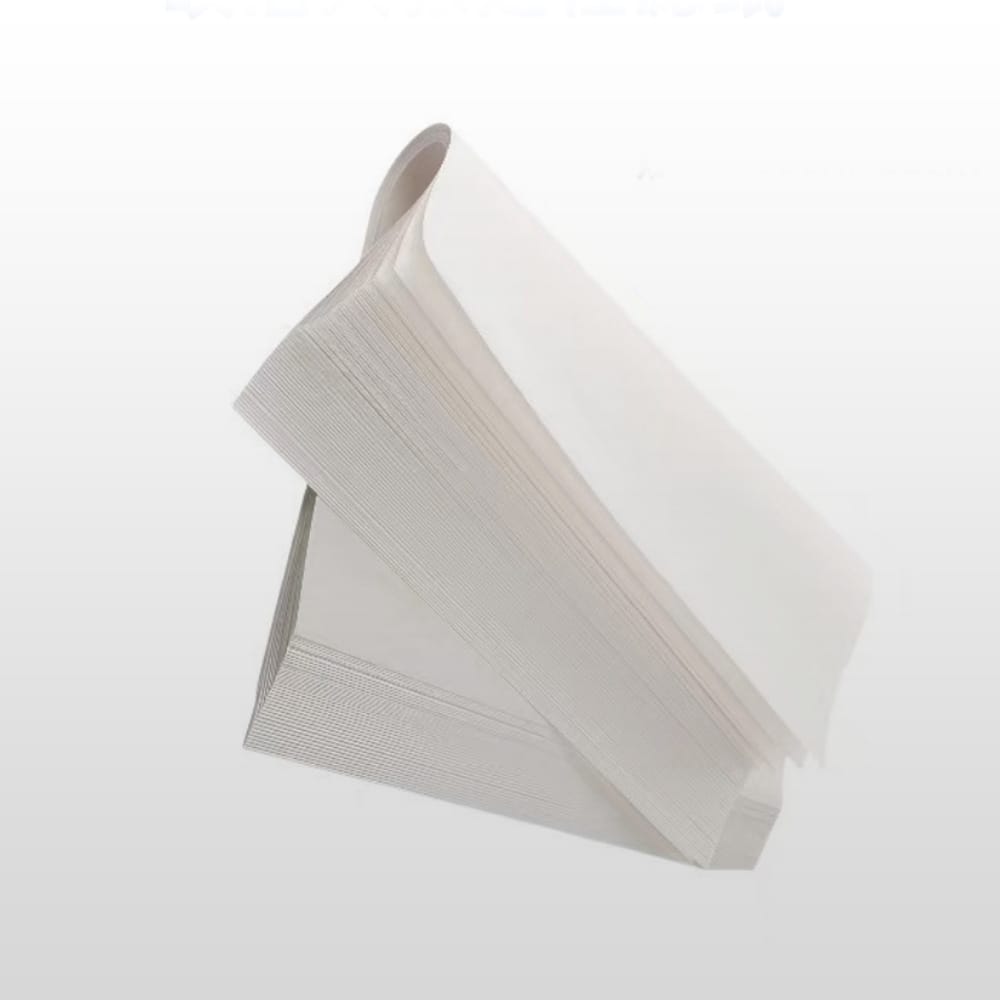
Filter paper GSM is the grammage of a sheet: its mass in grams divided by its area in square meters. A paper identified as 100 GSM therefore has a nominal mass of 100 grams for every square meter of material.
The official ISO 536 method for determining paper grammage provides a standardized basis for this measurement. In purchasing documents, the supplier should identify both the target grammage and the allowed variation.
The Basic Calculation
The formula is:
GSM = sample mass in grams ÷ sample area in square meters
For example, a sample measuring 200 mm × 250 mm has an area of 0.05 m². If it weighs 5.0 g, the calculated grammage is:
5.0 g ÷ 0.05 m² = 100 g/m²
A small specimen can be used, but cutting and weighing errors become more influential as the sample area decreases. A representative check should use accurately cut specimens from several positions across the web or sheet, then report individual results, the average, and the observed range.
Nominal GSM vs Actual GSM
The number on a technical data sheet is usually a target or nominal value. Actual filter paper GSM varies within a controlled tolerance because paper is formed from a moving fiber suspension, not machined from a perfectly uniform solid block.
The purchasing question is therefore not only “What is the GSM?” It is also:
- What tolerance applies?
- Which test method is used?
- How many specimens are tested?
- Where are they cut from?
- Is the result reported by roll, lot, or production run?
- What action is taken when cross-web variation is excessive?
Why Higher GSM Does Not Mean Finer Filtration
Filter paper GSM tells you how much material exists in a given area. It does not directly describe the size, shape, or connectivity of the spaces between fibers.
Particle retention is controlled by the paper’s pore network and by the way particles interact with that network. Fiber diameter, fiber length, refining, sheet formation, compression, creping, surface treatment, and bonding can all change filtration behavior without creating a simple one-to-one relationship with grammage.
A Heavier but More Open Structure
A high-GSM paper can be made with a bulky, open structure. It may offer useful depth and solids capacity while still allowing relatively fast flow. Its greater mass does not prove that it will capture the smallest particles.
A Lighter but Denser Structure
A lower-GSM paper can be more highly compacted or formed with a tighter pore network. It may retain smaller particles but create greater resistance to flow. Again, filter paper GSM alone cannot reveal that behavior.
Retention Is a Performance Claim
When a supplier states a micron value, ask how it was established. The response should define:
- Test particles or challenge contaminant
- Test liquid
- Flow or pressure conditions
- Efficiency threshold
- Whether the rating is nominal, absolute, or based on another definition
- Whether the result applies to clean paper or a developed filter cake
Without this information, a GSM value and an unsupported micron number do not form a complete filtration specification.
Filter Paper GSM vs Thickness, Density, and Porosity
Filter paper GSM becomes more useful when it is compared with thickness. The ISO 534 paper thickness and apparent density method distinguishes single-sheet thickness from bulking thickness and provides a basis for calculating apparent density and specific volume.
| Property | What It Describes | What It Does Not Prove |
|---|---|---|
| Filter paper GSM | Mass per unit area | Pore size, filtration efficiency, or liquid flow |
| Thickness | Distance between the two paper surfaces under a stated measuring pressure | Mass, strength, or retention by itself |
| Apparent density | Relationship between grammage and thickness | Exact pore-size distribution |
| Apparent specific volume or bulk | Volume occupied per unit mass | Guaranteed dirt capacity |
| Air permeance | Air passage under a defined pressure and test method | Flow rate with the buyer’s process liquid |
| Particle retention | Capture behavior under defined test conditions | Wet strength, fit, or service life |
Equal GSM, Different Thickness
Imagine two papers with the same filter paper GSM. Paper A is thinner and more compact; Paper B is thicker and bulkier. Their mass per area is equal, but their internal structures are not.
Paper A may offer greater flow resistance and lower depth capacity. Paper B may provide more internal space for particles but could be more compressible. These are possibilities to be tested, not conclusions that can be drawn from GSM and thickness alone.
Equal Thickness, Different GSM
Two papers can also have similar thickness but different grammage. The heavier sheet has a higher apparent density, yet this still does not prove better retention. Fiber type, paper formation, and compression determine how that additional mass is distributed.
Why Measuring Pressure Matters
Filter paper is compressible. A thickness gauge that applies a different pressure or uses a different contact area can produce a different result, especially with bulky or creped material.
For a meaningful supplier comparison, the test method and measurement conditions must be consistent.
How Filter Paper GSM Influences Strength and Handling
Although filter paper GSM does not determine filtration precision, it often affects handling performance. Increasing mass per unit area can provide more fiber network to carry load, but strength still depends on fiber quality, bonding, direction, moisture, and any wet-strength treatment.
Dry Handling
During converting and installation, the paper must withstand cutting, winding, transport, unfolding, clamping, and web tension. A very light grade may crease or damage more easily, but a higher-GSM paper can also track poorly if it is too stiff for the equipment path.
Wet Operation
Once saturated, dry feel becomes a poor predictor of performance. A paper can seem robust in the hand and weaken rapidly in liquid.
Wet tensile strength, wet burst behavior, support geometry, differential pressure, and filter-cake load should be evaluated separately. Our wet strength filter paper guide explains how tearing, sagging, and edge bypass develop during operation.
Machine and Cross Direction
Paper properties may differ between the machine direction and cross direction because fibers tend to orient during formation. This can influence tensile strength, elongation, roll handling, and tear behavior.
If directional performance matters, a technical data sheet should report the test direction rather than presenting one unexplained value.
How GSM Interacts With Flow and Dirt-Holding Capacity
Filter paper GSM can influence flow and capacity, but it does so through the paper structure. Adding mass while holding all other variables constant would usually create a longer or more resistant flow path. In real papermaking, however, other variables rarely remain constant.
Clean-Paper Flow
Clean-paper flow describes the initial passage of liquid before significant solids have accumulated. It is affected by:
- Open area and pore connectivity
- Thickness and compression
- Liquid viscosity
- Surface wetting
- Applied pressure or vacuum
- Effective filtration area
- Support-screen resistance
Air-permeance testing can help compare production consistency. The ISO 5636-5 Gurley method measures air permeance or air resistance within a defined range, but the standard also notes that rough surfaces can create clamping and leakage limitations.
An air result should never be presented as a guaranteed oil or coolant flow rate. Air and liquids differ in viscosity, density, surface tension, and interaction with cellulose.
Developing Filter Cake
As filtration continues, captured solids form a cake on or within the sheet. That cake can become the main source of resistance. A grade with fast clean-paper flow may slow sharply if fine particles seal its surface. Another grade may accept particles into a deeper structure and maintain flow longer.
This is why filter paper GSM must be evaluated over a full operating cycle, not during the first few minutes only.
Dirt-Holding Capacity
A thicker, bulkier paper may have more internal volume available for contaminants, but actual dirt-holding capacity depends on particle size, shape, compressibility, concentration, and where capture occurs.
GSM alone cannot predict the mass of solids a paper will hold before reaching a terminal pressure, overflow condition, or unacceptable flow rate.
Why the Same GSM Performs Differently in Different Liquids
A filter paper GSM that performs well in one process can fail in another because the paper is only one part of the filtration system.
Viscosity
Viscous liquids move through a porous medium more slowly than low-viscosity liquids under comparable conditions. Cold lubricating oil may therefore show a much lower flow rate than water, even when the same sheet and filtration area are used.
Temperature
Temperature can change liquid viscosity and may also influence the dimensions and mechanical behavior of cellulose paper. A trial should cover the normal operating range rather than one convenient room-temperature point.
Solids Load and Particle Shape
A low concentration of coarse particles may build a permeable cake. Fine, plate-like, sticky, or deformable solids may blind the surface quickly.
The same filter paper GSM can consequently deliver very different cycle times in transformer oil, machining coolant, plating solution, or another industrial liquid.
Chemistry and Wetting
Water, oil, emulsions, solvents, and chemical solutions do not wet paper identically. Process additives may change surface behavior, swelling, strength, or fiber release.
Compatibility trials should look for softening, discoloration, dimensional change, delamination, and changes in filtrate quality.
How to Select Filter Paper GSM by Application

There is no universal “best” filter paper GSM. Selection should begin with the process goal and the current failure, then narrow the options through controlled trials.
| Application Condition | Likely Priority | What to Compare Beyond GSM |
| Low-solids liquid clarification | Stable flow and acceptable clarity | Permeability, retention, surface uniformity |
| Fine sludge or abrasive swarf | Cake behavior and useful cycle time | Pore structure, thickness, wet strength, full-cycle flow |
| Viscous oil | Flow at operating temperature | Liquid-flow test, area, pressure, compatibility |
| Roll-fed coolant filtration | Tracking and resistance to tearing | Width tolerance, core, winding, directional tensile strength |
| Plate-and-frame filtration | Sealing and pressure support | Sheet dimensions, thickness, wet tensile, support pattern |
| Chemical liquid filtration | Compatibility and cleanliness | Fiber composition, extractables, pH, strength after exposure |
Oil and Industrial Liquid Filtration
For oil filtration, start with oil type, operating temperature, viscosity, contaminant, flow demand, and equipment pressure. A heavier grade may improve handling or capacity, but it can also reduce throughput if its structure is too restrictive.
Buyers can review the industrial filter paper roll guide for roll width, core, winding, and equipment-fit considerations.
Cutting Fluid and Coolant Filtration
Machining operations generate different contaminants. Grinding often produces fine sludge, while sawing and turning may produce larger chips.
Do not choose filter paper GSM from machine type alone. Identify the contaminant distribution, required coolant cleanliness, tank condition, filter-bed area, and paper advance trigger.
Transformer and Lubricating Oil
These applications may involve long cycles, variable viscosity, retained sludge, and pressure-assisted equipment. Compare initial clarity, end-of-cycle integrity, flow decline, and visible bypass.
GSM is useful for confirming material consistency after the suitable grade has been identified, but it should not be used as the initial stand-alone selection rule.
How to Compare Filter Paper Samples Correctly
A good trial separates material differences from changes in the process. If each sample is tested with a different temperature, solids load, area, or operating time, the results cannot be compared reliably.
Step 1: Define the Decision
Choose a primary objective:
- Increase flow without losing required clarity
- Improve clarity without causing premature blockage
- Reduce tearing or web breaks
- Extend the useful filtration cycle
- Improve roll tracking and sealing
- Reduce variation between deliveries
Step 2: Record the Baseline
Document the current paper, filter paper GSM, thickness, roll or sheet dimensions, current flow, cycle time, filtrate condition, failure pattern, and replacement trigger.
Also record the fluid temperature, approximate viscosity, solids load, equipment type, filtration area, and applied pressure or vacuum.
Step 3: Condition and Identify Samples
Moisture can affect paper mass, dimensions, and mechanical properties. The ISO 187 standard atmosphere provides a recognized framework for conditioning and testing paper, board, and pulp.
For an internal comparison, condition all samples in the same environment and label them with codes. This reduces handling differences and subjective bias.
Step 4: Measure More Than GSM
For each candidate, record:
- Individual and average grammage
- Cross-web grammage range
- Single-sheet thickness
- Apparent bulk or density, if calculated
- Dry and wet strength
- Air permeance, when appropriate
- Dimensions and tolerances
- Visual formation
- Edge quality and roll winding
Step 5: Run the Real Fluid
Use the actual process liquid and representative contamination. Keep filtration area, starting temperature, solids concentration, and pressure conditions as consistent as practical.
Record both startup and end-of-cycle behavior. A sample should not win merely because it delivers the fastest first liter.
Step 6: Compare Outcomes
| Trial Metric | Why It Matters |
| Initial flow | Shows clean-medium resistance |
| Flow decline over time | Shows how the paper and cake behave together |
| Total volume processed | Supports cycle-capacity comparison |
| Filtrate clarity or particle result | Confirms whether the quality target is met |
| Terminal pressure or overflow time | Identifies the usable operating window |
| Paper integrity at removal | Reveals wet-strength and support problems |
| Edge leakage or bypass | Separates fit problems from media problems |
| Repeat-trial variation | Shows whether the result is reproducible |
What a Useful Technical Data Sheet Should Show
A technical data sheet should make filter paper GSM comparable, not merely visible. At minimum, the buyer should expect the property, unit, target or typical value, tolerance where relevant, and test method.
Core Material Properties
- Fiber composition
- Filter paper GSM and tolerance
- Thickness and tolerance
- Moisture content or conditioning basis
- Apparent density or bulk, where useful
- Surface type or finish
Performance Properties
- Air permeance or air resistance with method
- Liquid filtration time or flow test with the test liquid
- Particle retention with efficiency definition
- Dry tensile strength by direction
- Wet tensile or wet burst with wetting procedure
- Chemical compatibility information
Converting and Supply Properties
- Sheet length and width tolerances
- Roll width and length
- Core inside diameter
- Maximum roll diameter
- Winding direction
- Joint policy
- Packaging and storage conditions
- Lot identification and traceability
A certificate of analysis does not need to reproduce every development test, but it should report the agreed release properties for the supplied lot.
How Manufacturers Control GSM Across a Roll
Average filter paper GSM can appear acceptable even when local thin and heavy zones exist. Those variations can produce weak spots, uneven flow, premature surface blinding, or unstable web tension.
Machine-Direction Variation
Changes over the length of a roll may come from stock consistency, flow, machine speed, moisture, drying, or control response. Trend data can reveal drift that one average number hides.
Cross-Direction Variation
Variation across the web can indicate uneven stock distribution, drainage, pressing, or drying. For wide industrial rolls, cross-web sampling is important because different lanes of the same roll may otherwise perform differently.
Formation Matters
Good formation means fibers are distributed relatively evenly rather than clustered into heavy flocs and thin windows. Two lots can meet the same average filter paper GSM while having different formation quality.
Visual inspection, transmitted-light review, localized grammage checks, thickness mapping, and performance testing can provide a more complete picture.
Common Buying Mistakes
Ordering “The Highest GSM Available”
The highest value may add stiffness, pressure drop, or unnecessary material without improving required retention. Start from the filtration target and equipment limit.
Converting GSM Directly Into Microns
There is no universal conversion from filter paper GSM to micron rating. The same grammage can be engineered into different pore structures.
Comparing Values With No Test Method
Results obtained with different specimen conditioning, thickness pressure, air apparatus, liquid, or efficiency definition are not directly comparable.
Ignoring Tolerance
A nominal value without an agreed tolerance leaves the acceptable delivery range unclear. The order should state both target and limits.
Testing With Water for an Oil Application
Water trials can provide an initial screen, but they do not reproduce oil viscosity, temperature behavior, surface wetting, or actual sludge.
Approving One Specimen
One well-performing sheet does not establish lot consistency. Compare multiple specimens and repeat the process trial with the leading grade.
What to Include in a Filter Paper RFQ

To receive a technically relevant recommendation, send more than a requested filter paper GSM. Include:
- Process liquid and main chemical components
- Normal and maximum temperature
- Approximate viscosity at operating temperature
- Contaminant type, size, shape, and concentration
- Required filtrate condition
- Equipment type and model
- Gravity, vacuum, or pressure operation
- Filtration area and normal flow
- Current paper specifications
- Current failure or improvement target
- Sheet or roll dimensions and tolerances
- Core size, roll diameter, and winding direction
- Required test documents and traceability
- Expected order volume and packaging needs
If a current sample is available, provide its TDS together with a used and unused specimen. A used sheet can reveal filter-cake distribution, edge bypass, creasing, and local stress that specifications alone do not show.
For sample matching or customized sheets and rolls, submit these details through our contact page.
FAQ
What does GSM mean in filter paper?
GSM means grams per square meter. It is the grammage or mass per unit area of the paper. Filter paper GSM is useful for production control and purchasing, but it does not directly specify pore size or filtration efficiency.
Is higher-GSM filter paper always stronger?
Not always. A higher value can contribute to strength, but fiber type, bonding, paper direction, moisture, formation, and wet-strength treatment also matter. Compare dry and wet mechanical results under stated methods.
Does higher GSM mean a smaller pore size?
No. There is no universal relationship that converts filter paper GSM into pore size. A heavier paper can have an open, bulky structure, while a lighter paper can be more compact.
Are GSM and thickness the same?
No. GSM measures mass per area; thickness measures sheet caliper under defined conditions. Evaluating both allows apparent density or bulk to be compared.
Can two filter papers have the same GSM but different flow rates?
Yes. Differences in fiber structure, thickness, compression, porosity, surface, and wetting can create different air and liquid-flow behavior even when grammage is equal.
What GSM should I use for oil filtration?
There is no universal value for all oils. Selection depends on viscosity, temperature, contamination, filtration area, pressure, required clarity, paper structure, and equipment fit. Test candidate grades with the actual oil.
How should filter paper GSM be checked when goods arrive?
Condition representative samples consistently, cut a known area accurately, weigh them on a suitable balance, and calculate grammage. Sample across the width and from more than one position or roll according to the agreed inspection plan.
Should a purchase order include a GSM tolerance?
Yes. State the target, tolerance, test method, sampling plan, and acceptance rule. This is more useful than listing only one nominal number.
Why did a heavier filter paper reduce output?
The new grade may have greater thickness, higher density, lower permeability, or a pore structure that blocks more quickly with the actual contaminant. Compare full-cycle flow, not filter paper GSM alone.
Which other values should be sent with GSM?
Send thickness, permeability or flow method, retention definition, dry and wet strength, dimensions, fluid data, operating conditions, and the required filtration result.
Conclusion
Filter paper GSM is an important material-control value, but it is not a complete filtration grade. It measures mass per unit area—not pore size, liquid flow, wet strength, filtration efficiency, or operating life.
The most reliable selection combines grammage with thickness, apparent density or bulk, permeability, defined particle retention, mechanical strength, dimensional tolerances, and full-cycle testing in the real process liquid. Buyers should also compare variation across a roll or lot, because a stable average can hide local weak or restrictive areas.
Use GSM to confirm that an approved material is being produced consistently. Do not use it as a shortcut for deciding which paper will filter finer, flow faster, or last longer.
For industrial oil, coolant, and chemical-liquid filtration, review our industrial filtration applications or send your process conditions, current grade, dimensions, and performance target through the contact page.