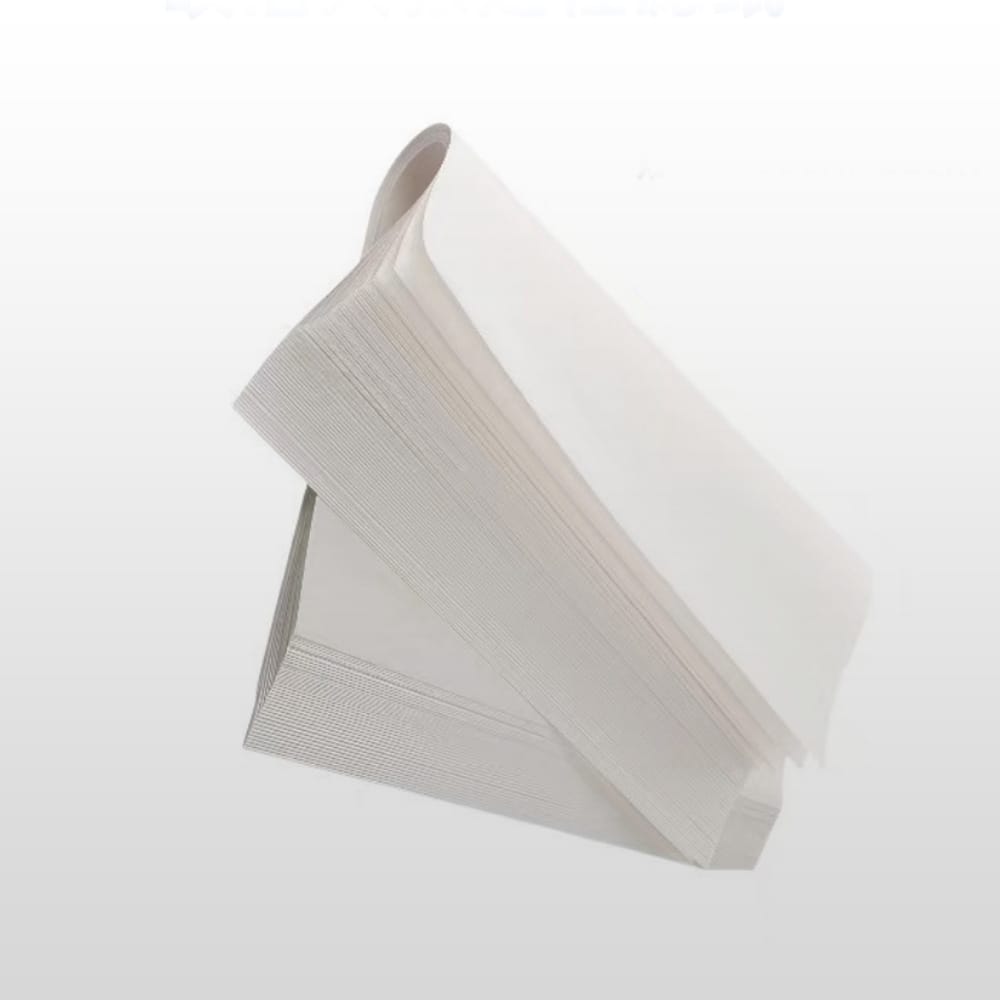
Wet strength filter paper is often selected only after standard paper tears, wrinkles, sheds fibers, or allows unfiltered liquid to escape around its edges. By that point, operators may already be dealing with contaminated fluid, an interrupted filtration cycle, extra cleanup, and an uncertain batch.
The better approach is to treat wet strength as one part of a complete filtration specification. A wet strength filter paper grade that is too restrictive can reduce throughput. A fast-flowing sheet that lacks strength can fail as the filter cake grows. A roll with good laboratory results can still perform poorly if its width, winding, or core does not match the equipment.
This guide explains how wet strength filter paper behaves in real filtration systems, which specifications buyers should compare, and how to test samples before a bulk order. Buyers looking for customizable sheets for oil and industrial liquid filtration can also review our large industrial filter paper.
Table of Contents
What Is Wet Strength Filter Paper?

Wet strength filter paper is a porous paper medium designed to retain enough mechanical integrity after it has absorbed or contacted a liquid. It must continue supporting the contaminant load and the forces created by liquid flow, handling, web tension, vacuum, or differential pressure.
Dry Strength and Wet Strength Are Not Interchangeable
A dry sheet can feel firm yet weaken quickly when saturated. Dry tensile strength describes how conditioned paper resists pulling before wetting. Wet tensile strength measures the force the paper can withstand after a defined immersion or wetting procedure.
The ISO 3781 wet tensile strength method describes testing paper after immersion in water for a specified period. For procurement, the reported value is useful only when the supplier also identifies the soaking time, test direction, sample conditioning, and test method.
Wet Strength Retention Adds Useful Context
Wet strength retention compares wet tensile strength with the dry tensile strength of the same material. It helps buyers understand how much mechanical performance remains after wetting.
However, neither a wet tensile value nor a retention percentage should be interpreted alone. Actual performance also depends on the fluid, equipment, contaminant load, filtration area, and operating pressure.
Why Wet Strength Filter Paper Tears After Saturation
Wet strength filter paper consists of a network of bonded fibers. When liquid enters that structure, the bonds and friction between fibers can weaken while the filter simultaneously becomes heavier and begins collecting solids.
A failure usually results from several stresses acting together rather than one isolated defect.
Growing Filter Cake
Particles accumulate on and within the wet strength filter paper, increasing resistance to flow. If the system continues feeding liquid at the same rate, differential pressure can rise.
A weak area, crease, unsupported span, or damaged edge may then become the point where the paper ruptures.
Poor Mechanical Support
Wet strength filter paper needs even support from the screen, plate, belt, or drainage surface below it. Large unsupported openings concentrate mechanical stress.
Sharp edges, damaged mesh, misaligned plates, and debris under the paper can puncture an otherwise suitable sheet.
Incorrect Roll Tension or Fit
In roll-fed equipment, excessive tension can stretch the wet strength filter paper, while insufficient tension can create folds and channels.
A roll that is too narrow leaves an unsealed path at the sides. A roll that is too wide may crease, ride against the equipment frame, or advance unevenly.
Fluid and Process Conditions
Viscosity, temperature, solids concentration, particle shape, chemical composition, and flow rate all influence paper stress.
A grade that runs reliably with warm, clean oil may behave differently with cold, viscous oil or an emulsion carrying abrasive fines.
Where Wet Strength Filter Paper Is Most Valuable
Wet strength filter paper is especially useful when the filtration medium must remain intact during long liquid contact, heavy solids loading, mechanical movement, or pressure-assisted filtration.
Transformer and Lubricating Oil Filtration
Oil purification equipment may expose filter sheets to long cycles, viscous fluid, retained sludge, and changing pressure.
Strength is needed to prevent rupture, but it must be balanced with absorption, permeability, and particle retention. For application-specific selection factors, see the transformer oil filter paper guide.
Cutting Fluid and Grinding Coolant Systems
Metalworking fluids can carry chips, fine swarf, abrasive particles, and sticky sludge. In gravity-bed and roll-fed systems, the wet paper must advance without tearing while supporting the growing filter cake.
Our cutting fluid filter paper guide explains how coolant type and machining process affect filter paper selection.
Filter Presses and Pressure-Assisted Systems
Plate, frame, vacuum, and pressure-assisted equipment can create higher mechanical stress than simple gravity filtration.
Wet strength filter paper used in these systems needs proper support, sealing, dimensional stability, and a tested operating window.
Chemical and Plating Solution Clarification
In chemical liquid filtration, mechanical strength alone is not enough. The fiber composition and any manufacturing additives must remain compatible with the process liquid.
Sample trials should check for swelling, softening, discoloration, fiber release, and changes in filtrate quality.
Seven Specifications to Check Before Buying
Wet strength filter paper should be evaluated as a performance system. The following specifications are more informative together than any single headline number.
| Specification | What It Helps You Evaluate | Risk When Misunderstood |
|---|---|---|
| Wet tensile strength | Resistance to pulling after controlled wetting | Web breakage during handling or operation |
| Wet strength retention | Strength remaining relative to the dry sheet | Overestimating performance from dry strength |
| Basis weight | Mass per unit area and production consistency | Assuming heavier paper is automatically stronger or finer |
| Thickness | Media depth, stiffness, and possible holding capacity | Reduced flow or poor equipment fit |
| Permeability or flow time | Resistance to fluid or air passage under a stated method | Overflow, slow cycles, or inadequate retention |
| Particle retention | Ability to capture particles under defined conditions | Cloudy filtrate or premature blockage |
| Dimensions and tolerances | Fit, sealing, roll tracking, and usable area | Bypass, wrinkles, trimming waste, or uneven advance |
Wet Tensile Strength
Ask for results in both the machine direction and cross direction when relevant. Wet strength filter paper properties can differ by direction because fibers are not always distributed identically.
The test report should identify:
- Test method
- Wetting liquid
- Immersion time
- Specimen direction
- Testing speed
- Result units
- Number of specimens tested
Basis Weight and Thickness
Basis weight and thickness influence handling and structure, but they are not direct substitutes for wet strength.
Two wet strength filter paper grades with the same grammage can have different porosity, fiber bonding, thickness, and tensile performance. The ISO 536 grammage method provides a standardized basis for measuring mass per unit area.
Permeability and Actual Liquid Flow
Air permeance can help monitor wet strength filter paper production consistency, while liquid-flow testing better represents the intended filtration process.
The ISO 5636-5 air permeance method also notes limitations when rough surfaces cannot be clamped without leakage. Therefore, an air-permeance value should not be treated as a guaranteed oil or coolant flow rate.
Why Air and Liquid Results Differ
Oil, coolant, emulsion, and water have different viscosities and surface behavior. Temperature can further change the way these fluids pass through the paper.
Air-permeance data can support batch comparison, but final selection should use the actual process liquid.
Particle Retention
Ask whether the stated micron value is nominal, absolute, or based on another efficiency definition. The supplier should identify the test particles, test liquid, pressure, and target efficiency.
Without a test method, two identical-looking micron claims may represent very different performance levels.
Chemical Compatibility
The buyer should provide the actual liquid composition, temperature range, pH where relevant, and expected contact time.
A compatibility check is especially important when the filtered liquid contains solvents, strong chemicals, process additives, or an unusual mixture.
Wet Strength vs Grammage vs Thickness
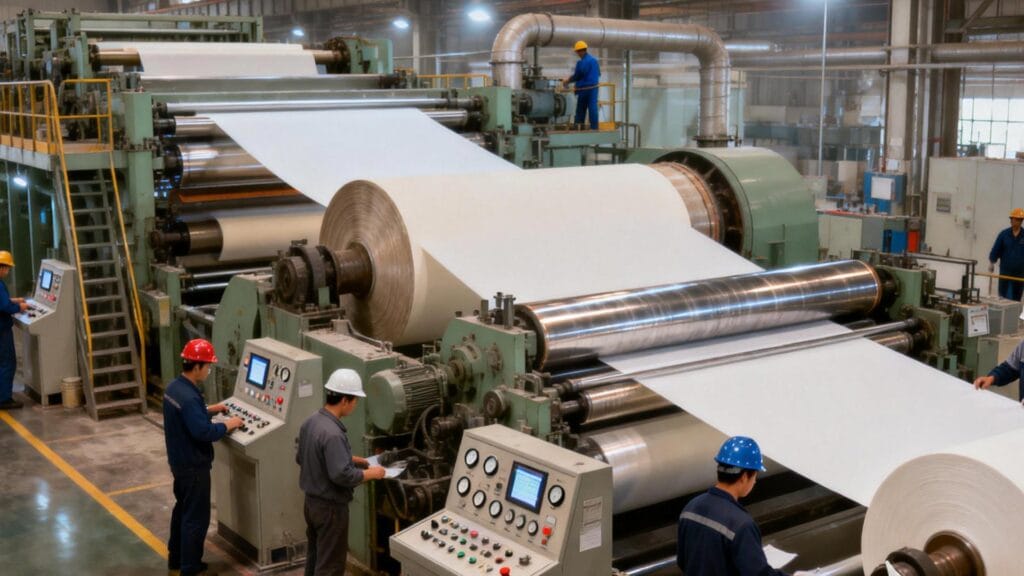
One of the most common purchasing errors is assuming that a higher GSM automatically means a stronger filter. Grammage, thickness, and wet strength describe different material properties.
Grammage
Grammage is the mass of paper per unit area. It is useful for verifying consistency and comparing grades, but it does not reveal how fibers are bonded or how the sheet behaves after saturation.
Thickness
Thickness affects stiffness, equipment fit, and the depth available for particle capture. A thicker sheet may hold more contaminants in some structures, but it may also increase flow resistance.
The result depends on porosity and paper formation, not thickness alone.
Wet Strength
Wet strength describes mechanical integrity after contact with liquid. A well-selected wet strength filter paper balances this integrity with the required flow, retention, and equipment fit.
Choosing the highest available strength without checking permeability can create a different problem: a durable paper that slows the filtration line or blocks too early.
How Equipment Design Changes the Requirement
The same wet strength filter paper will not perform identically in every machine. Equipment geometry determines how the liquid load is distributed and how quickly differential pressure develops.
Gravity-Bed and Conveyor Filters
These systems depend on stable tracking, sufficient roll width, controlled web tension, and smooth drainage support.
Buyers should confirm:
- Roll width
- Roll length
- Core inside diameter
- Maximum roll diameter
- Winding direction
- Edge tolerance
- Paper travel direction
The industrial filter paper roll guide provides a broader roll-specification checklist.
Plate-and-Frame Filter Presses
Sheet dimensions, hole positions, sealing surfaces, support patterns, and resistance to differential pressure are critical.
The paper should not bridge large unsupported openings. A trial should also check edge leakage and imprint marks that may indicate uneven loading.
Vacuum Filtration
Vacuum can accelerate filtration but also pulls the saturated sheet against its support.
The paper must resist deformation and tearing, while the support surface should distribute suction evenly. Testing should begin below the intended operating limit and increase gradually while the sheet is monitored.
Custom Oil Purification Equipment
For custom machinery, sending only width and length is rarely enough.
The supplier should receive a drawing or photographs showing:
- Paper path
- Support surface
- Sealing method
- Core dimensions
- Roll position
- Direction of movement
- Available installation space
How to Test Samples Before a Bulk Order
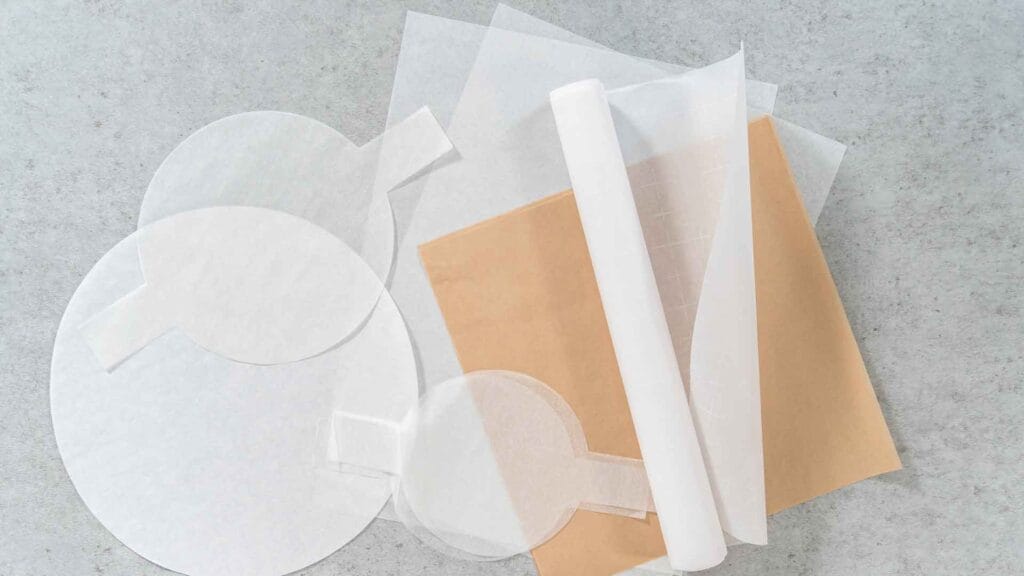
A controlled wet strength filter paper sample trial is more reliable than choosing from a specification sheet alone. The goal is to compare candidates under the same conditions and record measurable results.
Step 1: Define the Current Problem
State whether the priority is:
- Preventing paper tears
- Increasing filtration flow
- Improving filtrate clarity
- Extending the replacement interval
- Reducing edge bypass
- Fitting a new machine
- Reducing fiber release
A test without a defined goal can produce observations but no clear purchasing decision.
Step 2: Record the Process Conditions
Document the fluid, operating temperature, approximate viscosity, contaminant type, solids loading, flow rate, pressure or vacuum, filtration area, and normal cycle duration.
Also record the current paper size, installation method, and any known grade information.
Step 3: Condition and Identify Samples
Paper properties can change with temperature and humidity. For formal comparisons, use a controlled conditioning procedure such as the atmosphere described by ISO 187.
Assign each sample a code so operators can evaluate performance without being influenced by supplier identity.
Step 4: Establish a Dry and Wet Baseline
Measure wet strength filter paper dimensions, basis weight, thickness, and visible formation.
If testing equipment is available, compare dry tensile and wet tensile results. A basic soak-and-handle screening test can reveal obvious weakness, but it does not replace a controlled tensile test.
Step 5: Run the Actual Process Fluid
Water-based wet-strength data can support quality control, but it may not predict behavior in oil, coolant, or a chemical solution.
Run each sample with the real fluid and representative contamination. Keep the flow, filtration area, starting temperature, and solids loading as consistent as possible.
Step 6: Track the Full Filtration Cycle
Do not stop the test after the first clean filtrate appears.
Record:
- Startup flow
- Time until pressure rise or overflow
- Total volume processed
- Filtrate clarity
- Filter-cake behavior
- Paper deformation
- Edge leakage
- Fiber release
- Condition during removal
Wet strength filter paper must remain reliable near the end of the cycle, when contaminant loading and mechanical stress are usually highest.
Step 7: Repeat the Best Candidate
One successful test may be an outlier. Repeat the leading sample and, for critical operations, test material from more than one production lot.
The best choice is the grade that delivers a stable operating window rather than one unusually good result.
Troubleshooting Wet Filter Paper Failures
| Observed Problem | Likely Causes | What to Check Next |
| Paper tears near the center | Rising differential pressure, poor support, excessive solids | Support opening, pressure trend, loading, wet tensile result |
| Edge tearing | Wrong width, sharp guide, excessive tension, poor alignment | Roll fit, guide condition, web tension, edge tolerance |
| Liquid bypasses the paper | Undersized sheet, wrinkles, sealing failure | Dimensions, installation method, gasket or clamp condition |
| Paper stretches or sags | Low wet strength, large unsupported area, high liquid load | Wet tensile strength, support geometry, flow distribution |
| Flow falls too quickly | Restrictive paper, viscous fluid, high fine-particle load | Permeability, temperature, viscosity, staged filtration |
| Filtrate remains cloudy | Open retention, rupture, bypass, uneven seal | Paper integrity, retention method, edges, and support |
| Fibers appear downstream | Surface damage, incompatibility, weak formation | Fluid compatibility, handling, paper quality, support abrasion |
A stronger grade will not fix every failure. Bypass caused by incorrect width requires dimensional correction, while rapid blockage from excessive fines may require a more open grade, greater filtration area, or staged filtration.
What to Ask a Supplier Before Bulk Purchasing
A useful request for quotation should allow the supplier to understand the filtration process instead of guessing from a product name.
Include the following information:
- Filtered liquid and its main components
- Normal and maximum operating temperature
- Contaminant type and approximate particle size
- Solids loading
- Required filtrate quality
- Equipment type and model
- Gravity, vacuum, or pressure operation
- Roll or sheet dimensions and tolerances
- Roll length and core size
- Maximum roll diameter
- Current paper specification
- Current filtration failure
- Required documents and traceability
- Packaging requirements
- Expected order volume
- Sample-testing plan
Also ask the supplier to provide the test method behind each important value. Wet tensile strength without a soaking procedure, flow rate without a test liquid, and particle retention without an efficiency definition are incomplete specifications.
If you need help matching paper size and performance to an industrial filtration system, send the operating details through our contact page. Sample evaluation is most useful when the inquiry includes the actual fluid, equipment, dimensions, and current filtration problem.
Common Buying Mistakes to Avoid

Selecting Only by GSM
Higher grammage does not automatically mean better wet strength, finer retention, or longer service life. Compare the complete property set and test the candidate in the actual process.
Treating Micron Rating as a Complete Specification
A micron number says little without an efficiency definition and test method. It also does not describe wet strength, dirt-holding behavior, or flow with a specific liquid.
Testing Only with Clean Water
Clean-water screening of wet strength filter paper is convenient, but it does not reproduce oil viscosity, coolant additives, chemical compatibility, or the pressure created by a real filter cake.
Ignoring Machine and Cross Direction
Directional strength can affect roll tracking and web-break behavior. Where direction matters, ask how the paper should be installed and whether the supplier controls both directions.
Approving One Sheet Instead of a Representative Lot
A visually good sheet does not establish repeatability. Procurement should consider dimensional variation, basis-weight variation, winding consistency, and filtration performance across representative samples.
FAQ
What does wet strength mean in filter paper?
Wet strength is the paper’s ability to resist mechanical failure after contact with liquid. It is commonly evaluated through wet tensile testing, but practical performance must also account for pressure, support, loading, and the actual process fluid.
Is wet strength filter paper always thicker?
No. Thickness and wet strength are separate properties. Fiber selection, bonding, paper formation, and manufacturing treatment can change wet performance without producing the same change in thickness.
Can wet strength filter paper improve filtration accuracy?
It can help maintain filtration integrity by reducing tears and bypass, but wet strength alone does not determine particle retention. Filtration accuracy must be evaluated through a defined retention or efficiency test.
How can I tell if poor wet strength is causing a failure?
Repeated sagging, stretching, center rupture, edge tearing, or fiber release may indicate insufficient wet strength.
Confirm that equipment support, dimensions, pressure, and installation are correct before assuming the paper alone is responsible.
Should wet tensile strength be tested in water or the process liquid?
A standardized water-immersion test is useful for comparing production consistency.
A separate application trial with the real oil, coolant, emulsion, or chemical solution is still necessary because fluid properties and operating conditions can change performance.
Does higher GSM provide better wet strength?
Not necessarily. Higher GSM means more mass per unit area, but wet strength also depends on fiber bonding, formation, manufacturing processes, and paper direction.
Why does filter paper tear only near the end of a cycle?
The filter cake becomes heavier and more restrictive as particles accumulate. This can increase differential pressure and place greater stress on unsupported, damaged, or weaker areas of the paper.
What details are needed for a custom recommendation?
Provide the liquid, contaminants, temperature, pressure or vacuum, target clarity, equipment type, roll or sheet dimensions, core size, flow requirement, current paper, and current failure.
These details make sample selection much more reliable.
Conclusion
Wet strength filter paper should stay intact not only when first wetted, but also when the filter cake grows, pressure changes, and the cycle approaches its most demanding stage. Reliable selection therefore requires more than choosing a high GSM or a familiar micron rating.
Compare wet tensile strength, retention, grammage, thickness, permeability, dimensions, and chemical compatibility as a connected specification. Then verify the paper in the actual equipment with the real process liquid.
A structured sample trial can reveal tearing, bypass, premature blockage, and equipment-fit problems before they become production problems.
For industrial oil, coolant, and liquid filtration applications, review our industrial filtration applications or contact us with your operating conditions to discuss a suitable sheet or roll format.