
Table of Contents
Most avoidable filtration problems begin before a roll reaches the machine. This guide explains how to evaluate filter paper thickness tolerance for industrial sheets and rolls that must pass through guides, seals, clamps, and compact roll spaces. It is written for engineers, quality teams, maintenance staff, and buyers who need to show procurement and quality teams how to specify and verify thickness without confusing it with filtration rating. The aim is not to assign a universal pass value; it is to build a comparison that reflects the machine, liquid, solids, dimensions, and operating consequence.
A sound filter paper thickness tolerance review begins with a specific objective: protect machine fit and consistency while keeping the specification technically realistic. Write that objective at the top of the trial or inspection sheet. Then identify the current grade, roll width, core, outside diameter, lot, equipment, liquid condition, temperature, solids loading, and recent process changes. These details define the boundary of the conclusion and make later supplier discussions substantially more useful.
Use the eight checks below in sequence, but spend more time where the operating risk is highest. If the material is already causing tearing, bypass, unsafe access, overflow, or contamination, stop and follow the site’s safety and quality procedures before continuing. filter paper thickness tolerance should never require an operator to reach into moving equipment or collect a sample from an uncontrolled hazard.
Define the measured property
filter paper thickness tolerance must account for define the measured property. Define the measured property deserves its own check rather than being folded into a general media complaint. The practical reason is that caliper depends on the instrument pressure and contact area. For industrial sheets and rolls that must pass through guides, seals, clamps, and compact roll spaces, compare the affected condition with a retained or previously approved reference, using the same sampling position and conditioning whenever possible. Differences that disappear under controlled comparison should not be treated as proof of a lot defect.
To isolate this factor, state the method and conditioning instead of listing only a nominal number. Retain photographs or specimens when they can be collected safely, and label them with the lot, machine, position, and time. Those details allow filter paper thickness tolerance to support protect machine fit and consistency while keeping the specification technically realistic while protecting the team from a decision based on samples that were mixed or conditioned differently.
Connect thickness to machine fit
filter paper thickness tolerance must account for connect thickness to machine fit. Treat connect thickness to machine fit as a testable question. Because small changes accumulate across wound roll layers, a result from industrial sheets and rolls that must pass through guides, seals, clamps, and compact roll spaces is credible only when the liquid, solids loading, temperature, paper path, and production state are documented. Preserve roll labels and representative samples before making adjustments; otherwise the team may solve the symptom and lose the evidence needed to prevent recurrence.
The investigation should check outside diameter, available clearance, core size, and usable roll length. Compare the result with approved material under the same operating window and explain any limitation in the report. That discipline turns filter paper thickness tolerance into evidence for protect machine fit and consistency while keeping the specification technically realistic, rather than a broad claim that may not transfer to another liquid, machine, or roll width.
Do not treat caliper as pore size
filter paper thickness tolerance must account for do not treat caliper as pore size. The purpose of checking do not treat caliper as pore size is to separate material behavior from converting, installation, and machine effects. This matters because two sheets of similar thickness may have different fiber structures. A plant working with industrial sheets and rolls that must pass through guides, seals, clamps, and compact roll spaces should map the symptom across the web or sheet, note the distance from the roll start, and check whether the same pattern exists on unused material.
Document the check as you review permeability and retention data independently. Include abnormal production events instead of deleting them from the average; they may reveal the condition that actually controls failure. For filter paper thickness tolerance, the useful outcome is a bounded conclusion that advances protect machine fit and consistency while keeping the specification technically realistic and names the conditions where the conclusion no longer applies.
Control the sampling plan
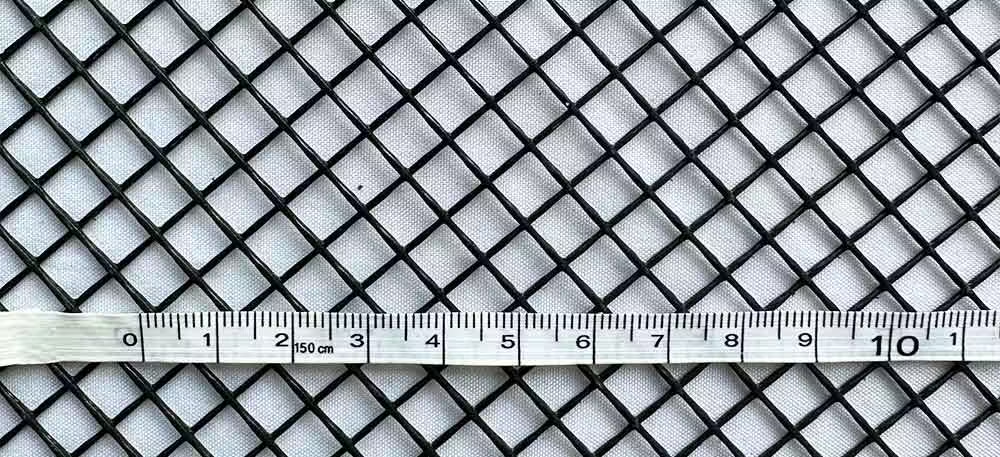
filter paper thickness tolerance must account for control the sampling plan. Control the sampling plan changes how the rest of the data should be interpreted. Since one edge measurement cannot represent an entire jumbo roll, the review should distinguish a local anomaly from a property that represents the full roll or lot. In industrial sheets and rolls that must pass through guides, seals, clamps, and compact roll spaces, take enough observations to include normal operating variation, but do not average away short events that trigger bypass, tearing, overflow, or unacceptable filtrate.
Use the available evidence to sample across the width and along the roll using a documented pattern. If the observations conflict, place the material on hold and define a focused follow-up rather than releasing it through an informal exception. A defensible filter paper thickness tolerance record should show how the chosen disposition supports protect machine fit and consistency while keeping the specification technically realistic.
Account for compression
filter paper thickness tolerance must account for account for compression. Before changing a grade, establish what account for compression looks like in acceptable production. That baseline is essential because nip pressure and clamping can reduce local caliper. The comparison for industrial sheets and rolls that must pass through guides, seals, clamps, and compact roll spaces should use the same instrument, units, sample orientation, and conditioning, with any deviations written into the record rather than corrected from memory later.
For the next comparison, observe the sheet at seals, guides, and support transitions. Assign an owner and a deadline, then state how the result will change the specification, setup sheet, inspection plan, or supplier request. This gives filter paper thickness tolerance an operational purpose tied directly to protect machine fit and consistency while keeping the specification technically realistic.
Inspect converted edges
filter paper thickness tolerance must account for inspect converted edges. A decision about inspect converted edges should be tied to a consequence. If slitting damage or telescoping can mimic a thickness problem, the relevant consequence may appear as handling damage, unstable liquid level, shortened run length, contaminant carryover, or excessive consumption. Select the consequence that matters in industrial sheets and rolls that must pass through guides, seals, clamps, and compact roll spaces and measure it alongside the paper property instead of treating the laboratory number as the final answer.
The working action is to separate roll-converting defects from base-sheet variation. Define the method, instrument, unit, sample location, and responsible person before collecting results. For filter paper thickness tolerance, connect every measurement to the stated objective: protect machine fit and consistency while keeping the specification technically realistic. A value without that decision context may be precise but still fail to tell purchasing or production what to do next.
Compare lots fairly
filter paper thickness tolerance must account for compare lots fairly. Compare lots fairly is most informative when checked at the point where the process changes. The underlying concern is that temperature, humidity, and method changes create false differences. For industrial sheets and rolls that must pass through guides, seals, clamps, and compact roll spaces, collect an as-found observation, a controlled comparison, and a post-adjustment observation. This three-part record prevents a temporary recovery from being mistaken for confirmation that the original material was unsuitable.
Use a controlled check to condition samples and use the same calibrated equipment. Change one relevant variable at a time and note what remained constant. This makes filter paper thickness tolerance repeatable and keeps the conclusion aligned with protect machine fit and consistency while keeping the specification technically realistic. If the check cannot be reproduced by another shift or supplier technician, the record needs more context before a lot is released or rejected.
Set an actionable tolerance
filter paper thickness tolerance must account for set an actionable tolerance. Start by observing set an actionable tolerance under the conditions found on the line. In industrial sheets and rolls that must pass through guides, seals, clamps, and compact roll spaces, a limit should trigger a defined review rather than automatic disposal. Record where the symptom begins, whether it is continuous or intermittent, and whether it follows a particular roll position, shift, batch, or maintenance event. This chronology is often more useful than an isolated photograph because it shows whether the paper condition precedes the process change or merely appears at the same time.
A practical next step is to link acceptance to equipment fit, trial results, and supplier investigation. Establish the acceptance rule before the test begins, including the observation period and any stop condition. The evidence for filter paper thickness tolerance should make it possible to pursue protect machine fit and consistency while keeping the specification technically realistic without relying on vague descriptions such as “better flow” or “stronger paper.”

filter paper thickness tolerance Decision Table
Use this filter paper thickness tolerance table to turn observations into decisions. The wording is deliberately application-specific: the entries point to evidence that can be collected in industrial sheets and rolls that must pass through guides, seals, clamps, and compact roll spaces. Replace the prompts with site limits, methods, owners, and escalation rules before the document becomes a controlled work instruction.
| Decision point | Why it matters | Evidence to collect | Disposition |
|---|---|---|---|
| Define the measured property | caliper depends on the instrument pressure and contact area | state the method and conditioning instead of listing only a nominal number | Pass, hold, controlled trial, or reject |
| Do not treat caliper as pore size | two sheets of similar thickness may have different fiber structures | review permeability and retention data independently | Pass, hold, controlled trial, or reject |
| Account for compression | nip pressure and clamping can reduce local caliper | observe the sheet at seals, guides, and support transitions | Pass, hold, controlled trial, or reject |
| Compare lots fairly | temperature, humidity, and method changes create false differences | condition samples and use the same calibrated equipment | Pass, hold, controlled trial, or reject |
Do not fill the last column after the result is known. Agree on the disposition rule in advance and state who has authority to approve an exception. For filter paper thickness tolerance, also record the observation period and production volume; a short stable interval may not represent a full roll, a changing coolant condition, or the solids generated by another product family.
A Practical Evaluation Protocol for filter paper thickness tolerance
First, preserve an as-found baseline for filter paper thickness tolerance. Photograph labels and relevant machine areas, retain representative samples, and capture the operating data available before adjustments. Note whether the symptom is new, gradual, cyclic, or associated with a material change. A baseline protects the investigation from hindsight and helps different departments describe the same event consistently.
Second, choose one primary variable and one approved reference. Run both options in industrial sheets and rolls that must pass through guides, seals, clamps, and compact roll spaces under the closest practical conditions. Record start and stop times, liquid level or differential pressure where applicable, advancement or change frequency, media consumption, filtrate appearance, cake behavior, web handling, and abnormal events. filter paper thickness tolerance becomes persuasive when the comparison explains both benefit and tradeoff.
Third, review the result against the objective to protect machine fit and consistency while keeping the specification technically realistic. A technically interesting difference is not automatically an operational improvement. Check whether it changes safety exposure, downtime, scrap, downstream cleanliness, maintenance workload, or the ability to maintain a stable process window. Name any unresolved uncertainty instead of converting it into an unsupported promise.
Finally, issue a bounded conclusion for filter paper thickness tolerance in industrial sheets and rolls that must pass through guides, seals, clamps, and compact roll spaces. State the equipment, liquid, temperature, solids, dimensions, lot, settings, observation period, and acceptance criteria covered by the result. Classify the outcome as approved, conditionally approved, requiring another controlled trial, or not suitable for the evaluated conditions. Store the record where purchasing, production, quality, and the supplier can retrieve it.
Technical References for filter paper thickness tolerance
A filter paper thickness tolerance procedure should cite sources that match the actual risk. Useful starting points include ISO machinery risk-assessment principles, OSHA hazardous-energy control requirements, OSHA machine-guarding requirements, NIOSH guidance on occupational exposure to metalworking fluids, U.S. EPA hazardous-waste resources. Confirm the rules and methods that apply to the facility, jurisdiction, equipment, and waste stream; these links are orientation resources, not a substitute for the site’s approved safety or environmental program.
For product and application context, compare large industrial filter paper, custom filter paper rolls, the filter paper permeability guide, the filter paper roll installation checklist, and the filter paper clogging troubleshooting guide. These internal resources help connect filter paper thickness tolerance with roll dimensions, permeability, installation, troubleshooting, and the industrial formats available for a controlled comparison.
filter paper thickness tolerance Questions from Plant Teams
Why should define the measured property be checked first?
Caliper depends on the instrument pressure and contact area. In a filter paper thickness tolerance review, state the method and conditioning instead of listing only a nominal number. Record the method and the application conditions so the answer can be repeated and so a result from industrial sheets and rolls that must pass through guides, seals, clamps, and compact roll spaces is not applied automatically to unrelated equipment or liquids.
What evidence is useful for connect thickness to machine fit?
Small changes accumulate across wound roll layers. In a filter paper thickness tolerance review, check outside diameter, available clearance, core size, and usable roll length. Record the method and the application conditions so the answer can be repeated and so a result from industrial sheets and rolls that must pass through guides, seals, clamps, and compact roll spaces is not applied automatically to unrelated equipment or liquids.
Can a supplier certificate resolve control the sampling plan?
One edge measurement cannot represent an entire jumbo roll. In a filter paper thickness tolerance review, sample across the width and along the roll using a documented pattern. Record the method and the application conditions so the answer can be repeated and so a result from industrial sheets and rolls that must pass through guides, seals, clamps, and compact roll spaces is not applied automatically to unrelated equipment or liquids.
How long should the inspect converted edges comparison run?
Slitting damage or telescoping can mimic a thickness problem. In a filter paper thickness tolerance review, separate roll-converting defects from base-sheet variation. Record the method and the application conditions so the answer can be repeated and so a result from industrial sheets and rolls that must pass through guides, seals, clamps, and compact roll spaces is not applied automatically to unrelated equipment or liquids.
What should the final record say about set an actionable tolerance?
A limit should trigger a defined review rather than automatic disposal. In a filter paper thickness tolerance review, link acceptance to equipment fit, trial results, and supplier investigation. Record the method and the application conditions so the answer can be repeated and so a result from industrial sheets and rolls that must pass through guides, seals, clamps, and compact roll spaces is not applied automatically to unrelated equipment or liquids.
Prepare a Useful filter paper thickness tolerance Request
Before requesting a sample or replacement for filter paper thickness tolerance, assemble the current grade, roll width, core size, outside diameter, equipment model, filtration area, liquid description, temperature range, solids, flow or production rate, pressure or level behavior, photographs, and the exact problem the change must solve. Include the acceptance rule and any constraint that cannot be changed.
For help reviewing filter paper thickness tolerance, contact the Fushun filter paper team with the available measurements and trial objective. The team can discuss suitable industrial filter-paper formats and sample requirements. Final selection should remain subject to equipment compatibility, safe installation, and verification in the customer’s actual process.